Disentangling the Delayed Choice Quantum Eraser
Download Paper
Twenty-five years ago, Yoon-Ho Kim and others published a paper in Physical Review Letters entitled “A Delayed Choice Quantum Eraser,” which caused quite a stir in the popular science media. Before long, a collection of books and articles appeared making some pretty far-fetched claims about an experiment that turned the arrow of time on its head and challenged the normal sequence of events from past to present.
I first became aware of the experiment in 2005 after reading a review article by Y. Aharonov and M.S. Zubairy in the journal Science (Science 307, 875). The review article piqued my interest enough that I then read the original paper by Kim et al. It was scant on details, but this concluding statement caught my eye:
“The experimental results demonstrate the possibility of observing both particle-like and wave-like behavior of a light quantum via quantum mechanical entanglement. The which-path or both-path information of a quantum can be erased or marked by its entangled twin even after the registration of the quantum.”
The authors didn’t straight-up claim that they could reach out from the present and change the past, but the idea of “erasing” quantum information after-the-fact came pretty close. That’s when I called my friend E. Brian Treacy. After kicking it around for a while, we decided to write a different interpretation of the experiment and submit it to Physical Review Letters, which we did. They rejected it because we purposefully avoided invoking quantum entanglement in our interpretation, which in retrospect was a mistake on our part because entanglement does play an important role in the experiment.
One useful way to think of the delayed choice quantum eraser experiment, and of entanglement in general, is to imagine a pair of identical twins. For example, if you happen to notice a physical trait on one twin that you hadn’t noticed before on the other twin, you’ve just made a “delayed” observation or “choice.” And because they are twins, you also know that the same traits of one will likely appear on the other, too.
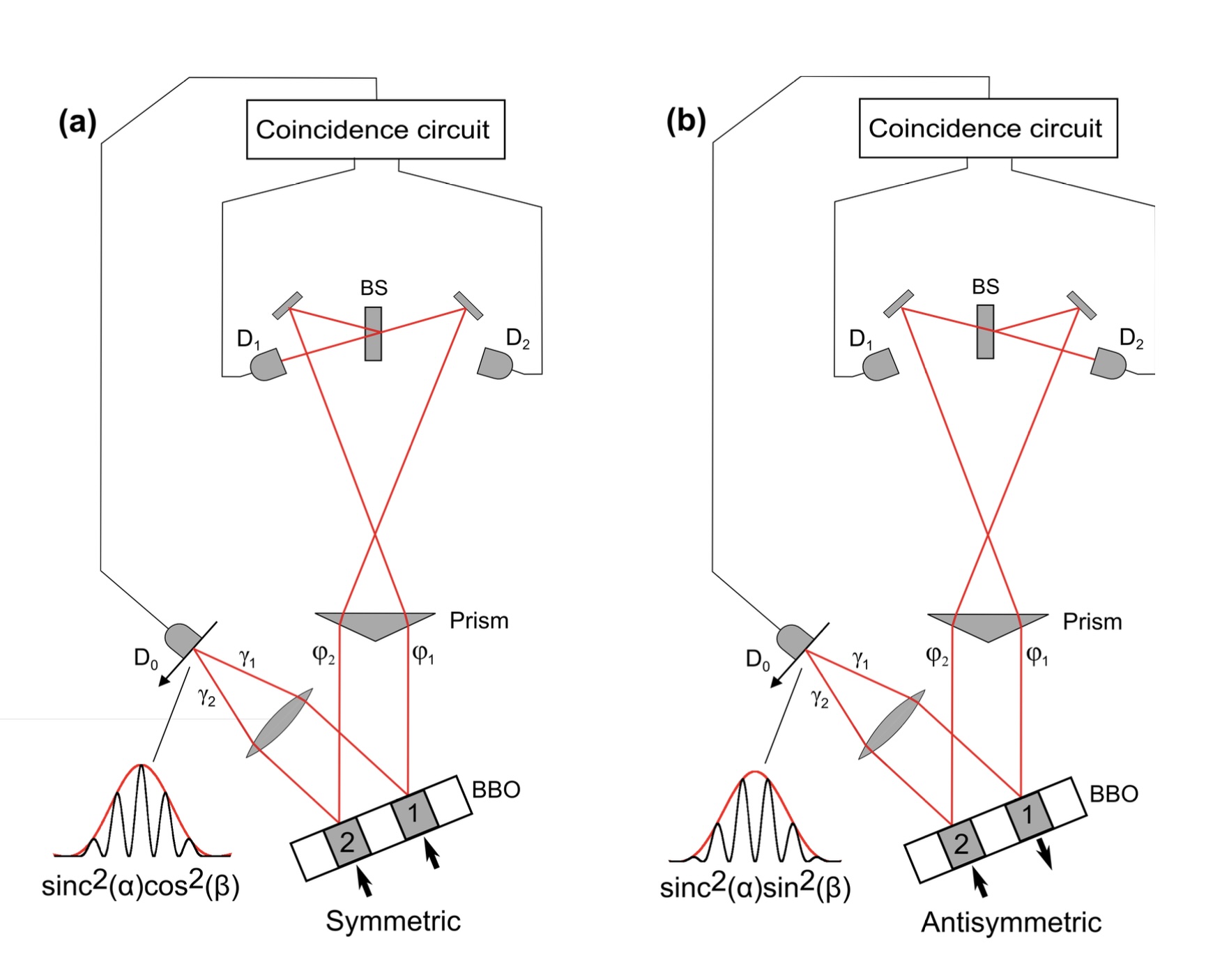
Figure 2 from our original 2005 paper depicts the delayed-choice interferometer used to sort the symmetric (a) and antisymmetric (b) radiation states of the entangled photon source (BBO) in the famous experiment by Kim et al.
The original experiment by Kim et al. demonstrated a similar effect (see figure above). By inducing interference among photons at one location and time, the experimenters demonstrated that their entangled photon twins, which had been detected earlier at another location, suddenly showed interference, too, even though they ordinarily displayed no such interference by themselves. In fact, the interference of a set of photons could be seen or “erased,” depending on how their entangled twins were detected at a later time. The present is not mysteriously affecting the past here, as some have proclaimed, it’s only revealing to you a common trait among twins that was shared all along but that you just didn’t (or couldn’t) see before.
Of course, the original experiment is more complicated than this, and there are other aspects to it, but it remains an elegant example of the spooky quantum property of entanglement in which the properties of multiple quanta can become correlated with one another and instantaneously act like a single quantum across space and time.
More recently, a number of publications (and even a couple of YouTube videos) have appeared debunking “retrocausal” interpretations of the Delayed Choice Quantum Eraser. Most of these criticisms point out that the original experiment by Kim and others is really a kind of sorting machine, which is exactly the point that Brian and I tried to make back in 2005.
Brian is gone, now, so I’ve rewritten our original 2005 paper myself, but with entanglement included this time. This one’s for you, Brian.
Here’s a PDF of the revised paper:
Delayed Choice Quantum Eraser
I also offer a new interpretation of the delayed-choice quantum eraser in my paper “Rolling the Dice on the Delayed-Choice Quantum Eraser.” This interpretation explains the experiment by using the stochastic metaphor of tossing two quantumly entangled dice. (See my posting “Rolling the Dice on the Delayed-Choice Quantum Eraser.”)