Publications
Published Writings:
Below is a limited sampling of previously published work that includes four installments of my serial book Back to Basics, a 22-part introduction to electro-optics originally published in Laser Focus World. Back to Basics was selected as a finalist for the Jesse H. Neal Award for best subject-related series.
Also included are a feature article on astronomy and a couple of Los Angeles Times science articles on how lasers are used to trap atoms and small particles. (Arthur Ashkin’s invention of the laser light trap earned him the 2018 Nobel Prize in physics at the age of 96.)
Each article is a downloadable PDF file intended only as an example of my writing. All articles are copyright protected and are not for republication or distribution of any kind.
Back to Basics:
Feature Article:
Los Angeles Times Feature Articles:
Capturing Atoms: First You Have to Slow Them Down
Also included below is a 2025 rewrite of a paper I originally wrote back in 2005 with my late friend E. Brian Treacy on the now famous Delayed Choice Quantum Eraser experiment. The results of this experiment have spawned many strange and fanciful interpretations, including “retrocausality,” in which it is suggested that effects can sometimes precede causes.
In our original 2005 paper, “Symmetry Sorting in a Delayed Choice Quantum Eraser,” we attempt to provide a much simpler explanation of the experiment’s results without having to invoke the quantum phenomenon of entanglement. I have since come to recognize that this approach is unsuitable, so I have rewritten our paper to include entanglement, since it does play an important role in the experiment’s results.
One useful way to think of the delayed choice quantum eraser experiment, and of entanglement in general, is to imagine a pair of identical twins. For example, if you happen to notice a physical trait on one twin that you hadn’t noticed before on the other twin, you’ve just made a “delayed” observation or “choice.” And because they are twins, you also know that the same traits of one will likely appear on the other, too.
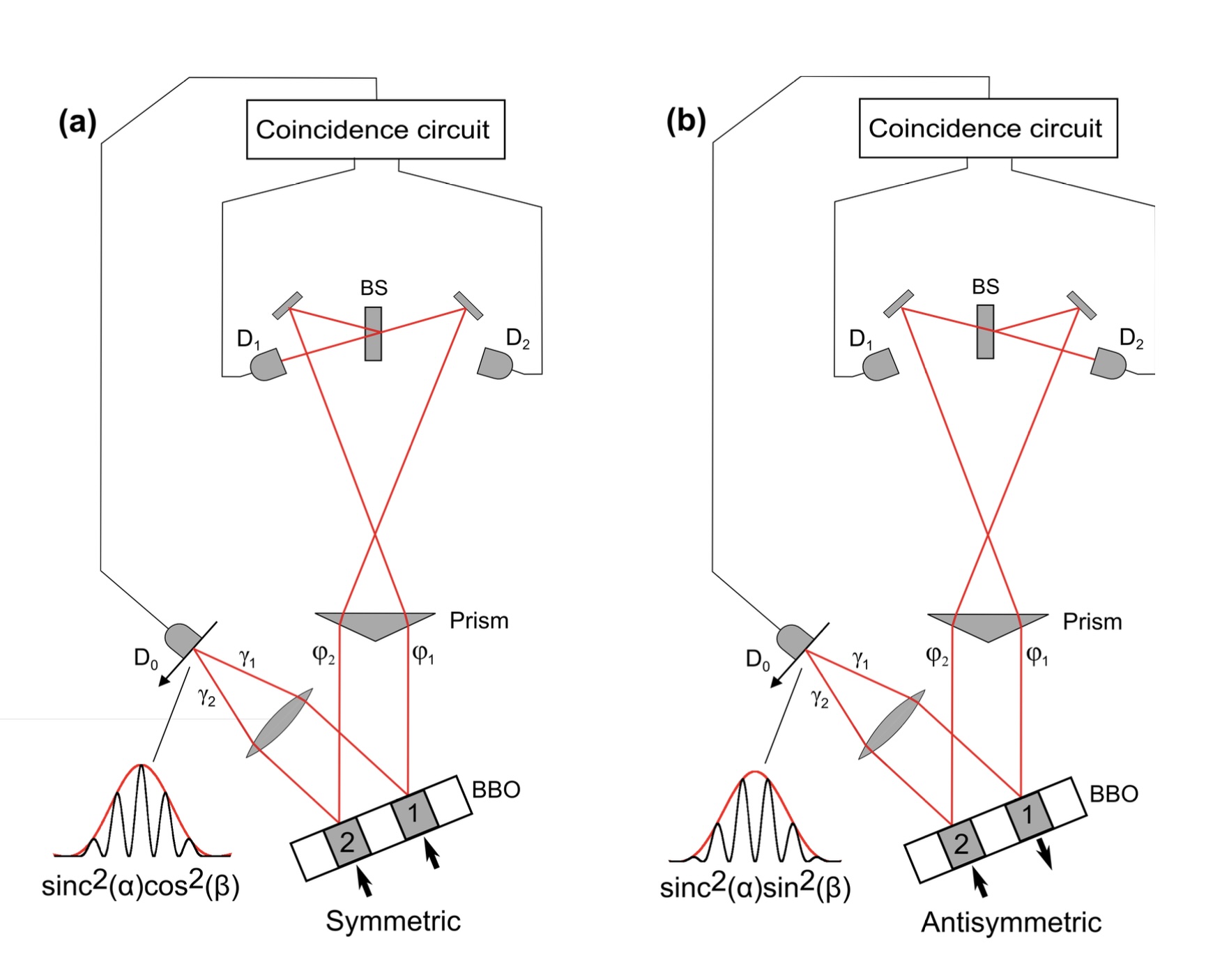
Figure 2 from our original 2005 paper depicts the delayed-choice interferometer used to sort the symmetric (a) and antisymmetric (b) states in the famous experiment by Kim et al.
The original experiment by Kim et al. demonstrated a similar effect (see figure above). By inducing interference among photons at one location and time, the experimenters demonstrated that their entangled photon twins, which had been detected earlier at another location, suddenly showed interference, too, even though they ordinarily displayed no such interference by themselves. In fact, the interference of a set of photons could be seen or “erased,” depending on how their entangled twins were detected at a later time. The present is not mysteriously affecting the past here, as some have proclaimed, it’s only revealing to you a common trait among twins that was shared all along but that you just didn’t (or couldn’t) see before.
Of course, the original experiment is more complicated than this, and there are other aspects to it, but it remains an elegant example of the spooky quantum property of entanglement in which the properties of multiple quanta can become correlated with one another and instantaneously act like a single quantum across space and time.
Here is a PDF of my 2025 rewrite:
Delayed Choice Quantum Eraser