Quantum Dice and the Delayed-Choice Quantum Eraser
A new interpretation of the delayed-choice quantum eraser

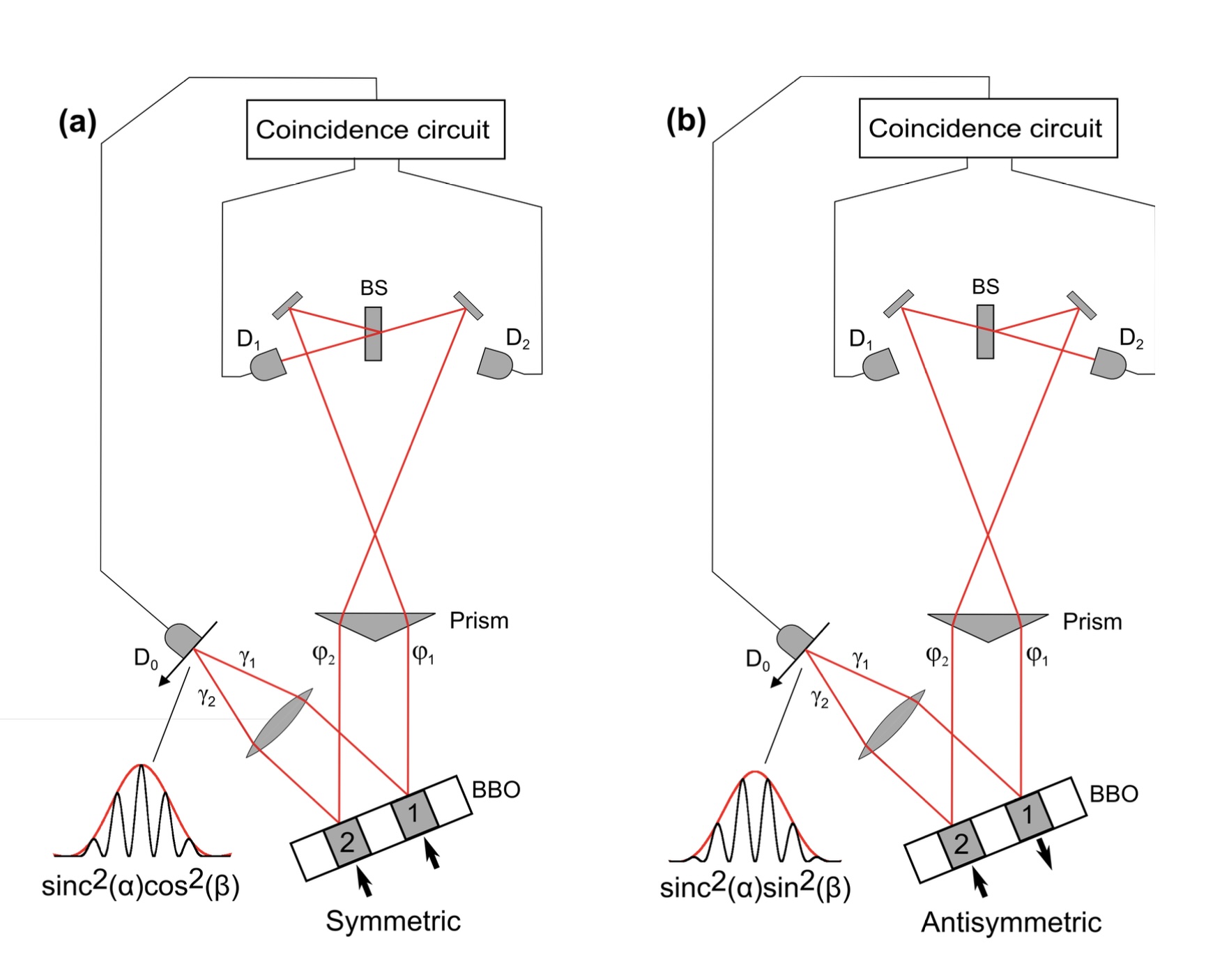
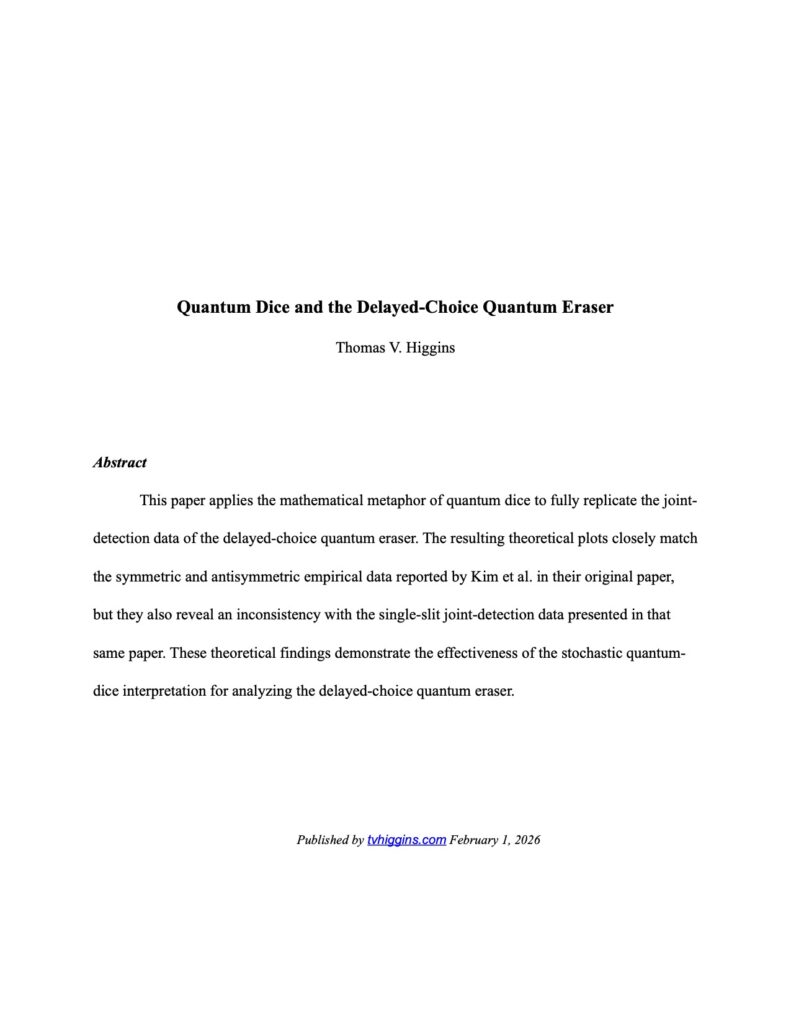
In my recent paper “Rolling the Dice on the Delayed-Choice Quantum Eraser,” I introduce a new interpretation of this famous experiment by equating its results to the random outcomes of a pair of entangled quantum dice. In this follow-up paper, I develop the interpretation further by using it to plot out the complete theoretical waveforms for all four joint-detection scenarios in the experiment.

Not only do the theoretical results closely mirror the symmetric and antisymmetric joint detections reported in the original paper by Kim et al., they also reveal an inconsistency with their data. Their reported single-slit joint-detection rates are too high to be part of the same data set that produced their double-slit joint-detection rates. Conservation of energy demands that the sum of the double-slit joint-detection rates and the sum of the single-slit joint-detection rates be equal. The single-slit joint-detection rates reported by Kim et al. lead to a sum that exceeds the sum of their reported double-slit data. One can only speculate on the cause, because the authors do not address this discrepancy in their paper.

The mathematical metaphor of entangled quantum dice offers a powerful and intuitive strategy for interpreting the utter randomness of the delayed-choice quantum eraser. By interpreting the experiment’s results as the random outcomes of a pair of entangled quantum dice, one can replicate the actual data with remarkable precision—and without violating the normal sequence of cause and effect. In so doing, this interpretation thoroughly refutes those upside-down “retrocausal” interpretations in which the present somehow affects the past.

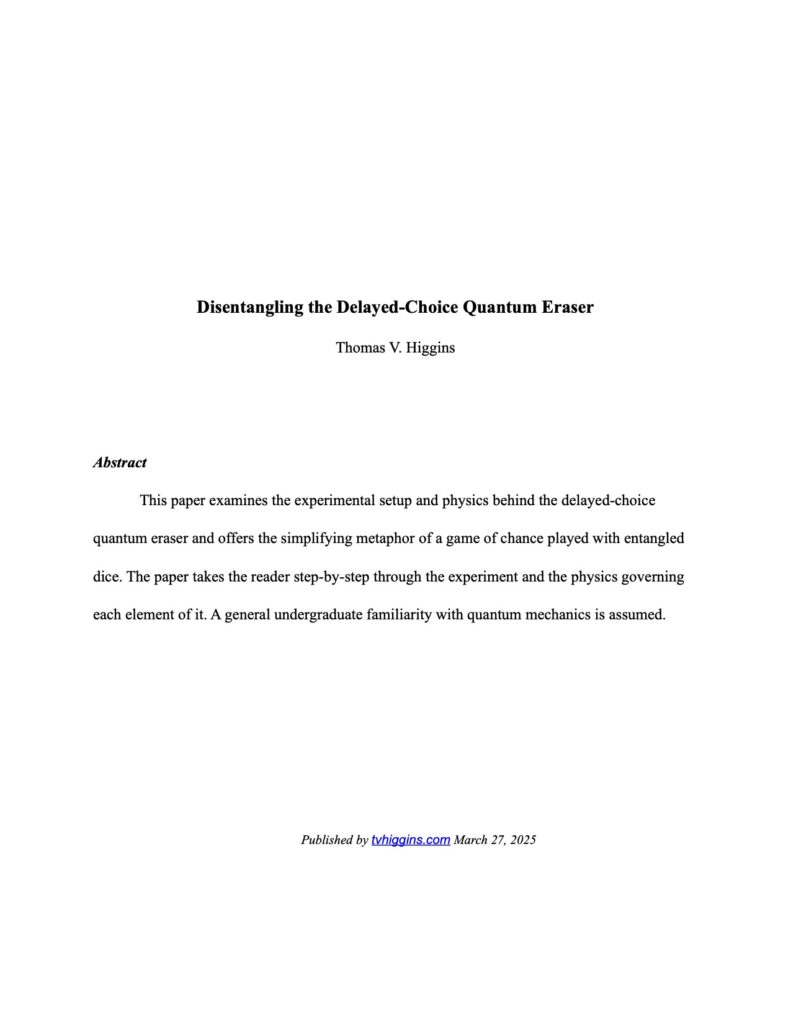
To download a PDF of my latest analysis of the delayed-choice quantum eraser, click here or on the abstract page above.

To download a PDF of my previous paper, which introduces the entangled-quantum-dice interpretation, click here: “Rolling the Dice on the Delayed-Choice Quantum Eraser.”

To download a PDF of my backgrounder on this experiment, click here: “Disentangling the Delayed-Choice Quantum Eraser.”
Rolling the Dice on the Delayed-Choice Quantum Eraser

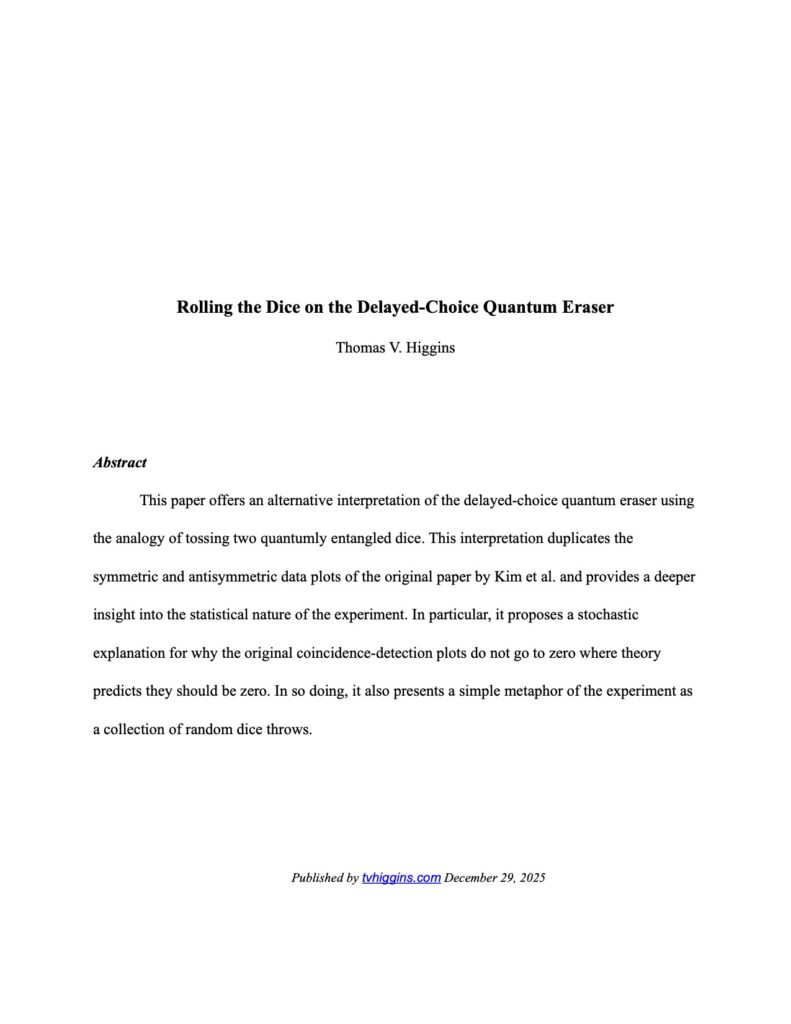
"Rolling the Dice on the Delayed-Choice Quantum Eraser": A new interpretation.
Download Paper

The delayed-choice quantum eraser has confounded many people for well over two decades, now. During that time, its peculiar results have spawned some pretty far-fetched interpretations, including the notion that the experiment demonstrates so-called “retrocausality,” in which effects precede causes. Not true. It turns out that it’s really a sorting machine, not a time machine.

Much of the challenge in comprehending this experiment stems from the scarcity of operational details given on it, starting with the original paper by Kim et al. Vital specifics are often ignored or taken for granted, leaving the uninitiated to fend for themselves.

Another obstacle for many is understanding the nature of the entanglement that exists between the photons bouncing around between detectors in the experiment, as well as the degree of coherence they exhibit during these interactions. Entanglement is the hardest aspect of the experiment for most to swallow—even Einstein called it “spooky action at a distance.”

Modern quantum theory offers some helpful mathematical guidance for dealing with entanglement. The following YouTube video gives an excellent quantum mechanical summary of the delayed-choice quantum eraser: https://www.youtube.com/watch?v=SCdbMhQ8Wrk.

Entanglement, according to QM, kills interference, which accounts for why we don’t see fringes at the scanning detector D0 in the experiment. Because of this “decoherence,” only a statistically mixed ensemble of the four possible wavefunctions exists at the signal detector D0. To the eye (and to D0), the combination of states looks like the clump pattern from two single slits. No interference fringes.

But coherence is not so much destroyed by entanglement as it is rendered inaccessible to direct local measurement. Consequently, to disentangle a pure wavefunction from the ensemble at D0, you must combine each signal detection with its twin’s detection at one of the four idler detectors. It’s as if the pure wavefunction exists only “in spirit” at D0., and to interact with it you must enlist the help of a “medium” in the form of correlated idler-twin detections. This is because the full wavefunction is actually shared by the entangled signal-idler photon pair, so it takes a series of correlated detections to get the full story.

Nonetheless, despite the “decoherence” from entanglement—and, indeed, because of it—the results of the delayed-choice quantum eraser can be accurately modeled using the metaphor of two quantumly entangled dice. In the paper presented above, I describe how such a model can reconstruct the symmetric and antisymmetric coincidence data of the original paper by Kim et al., thus providing a deeper insight into the stochastic nature of the experiment and contradicting those infamous “retrocausal” interpretations of the experiment.

To download the PDF of this paper click here or on the abstract page imaged above.

To download the PDF of my backgrounder on this famous experiment, click “Disentangling the Delayed-Choice Quantum Eraser.