Quantum Dice and the Delayed-Choice Quantum Eraser
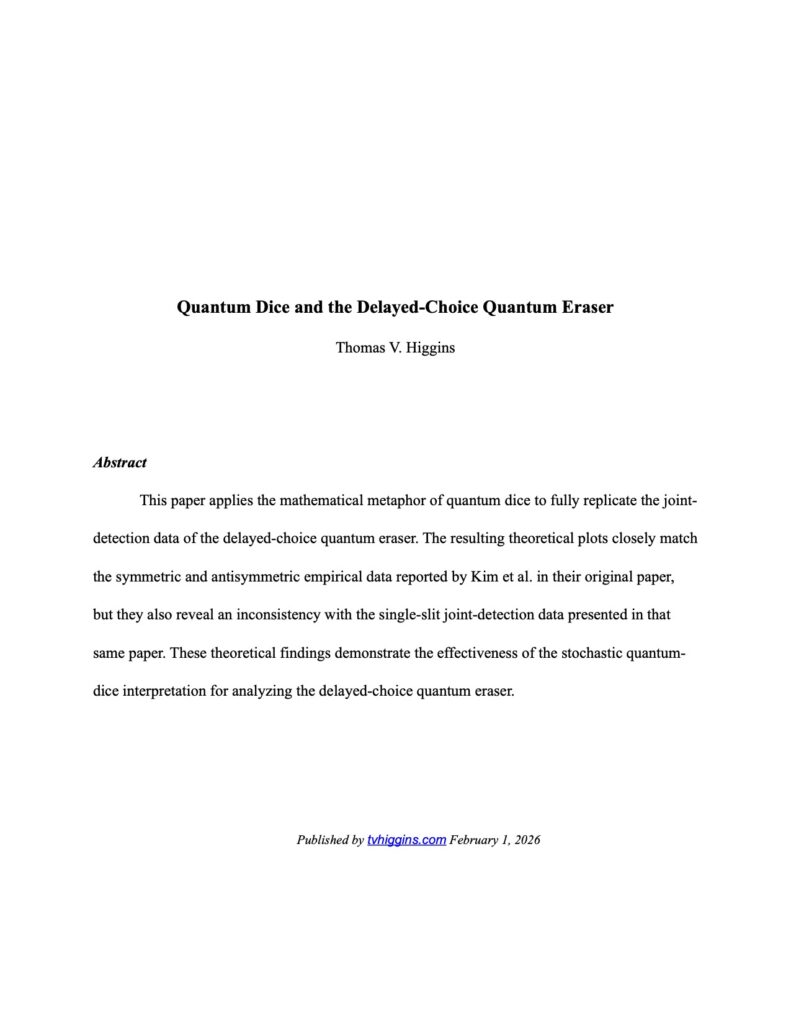
A new interpretation of the delayed-choice quantum eraser

In my recent paper “Rolling the Dice on the Delayed-Choice Quantum Eraser,” I introduce a new interpretation of this famous experiment by equating its results to the random outcomes of a pair of entangled quantum dice. In this followup paper, I develop the interpretation further by using it to plot out the complete theoretical waveforms for all four joint-detection scenarios in the experiment.

Not only do the theoretical results closely mirror the symmetric and antisymmetric joint detections reported in the original paper by Kim et al., they also reveal an inconsistency with their data. Their reported single-slit joint-detection rates are too high to be part of the same data set that produced their double-slit joint-detection rates. Conservation of energy demands that the sum of the double-slit joint-detection rates and the sum of the single-slit joint-detection rates be equal. The single-slit joint-detection rates reported by Kim et al. lead to a sum that exceeds the sum of their reported double-slit data. One can only speculate on the cause, because the authors do not address this discrepancy in their paper.

The mathematical metaphor of entangled quantum dice offers a powerful and intuitive strategy for interpreting the utter randomness of the delayed-choice quantum eraser. By interpreting the experiment’s results as the random outcomes of a pair of entangled quantum dice, one can replicate the actual data with remarkable precision—and without violating the normal sequence of cause and effect. In so doing, this interpretation thoroughly refutes those upside-down “retrocausal” interpretations in which the present somehow affects the past.

To download a PDF of my latest analysis of the delayed-choice quantum eraser, click here or on the abstract page above.

To download a PDF of my previous paper, which introduces the entangled-quantum-dice interpretation, click here: “Rolling the Dice on the Delayed-Choice Quantum Eraser.”

To download a PDF of my backgrounder on this experiment, click here: “Disentangling the Delayed-Choice Quantum Eraser.”
Rolling the Dice on the Delayed-Choice Quantum Eraser

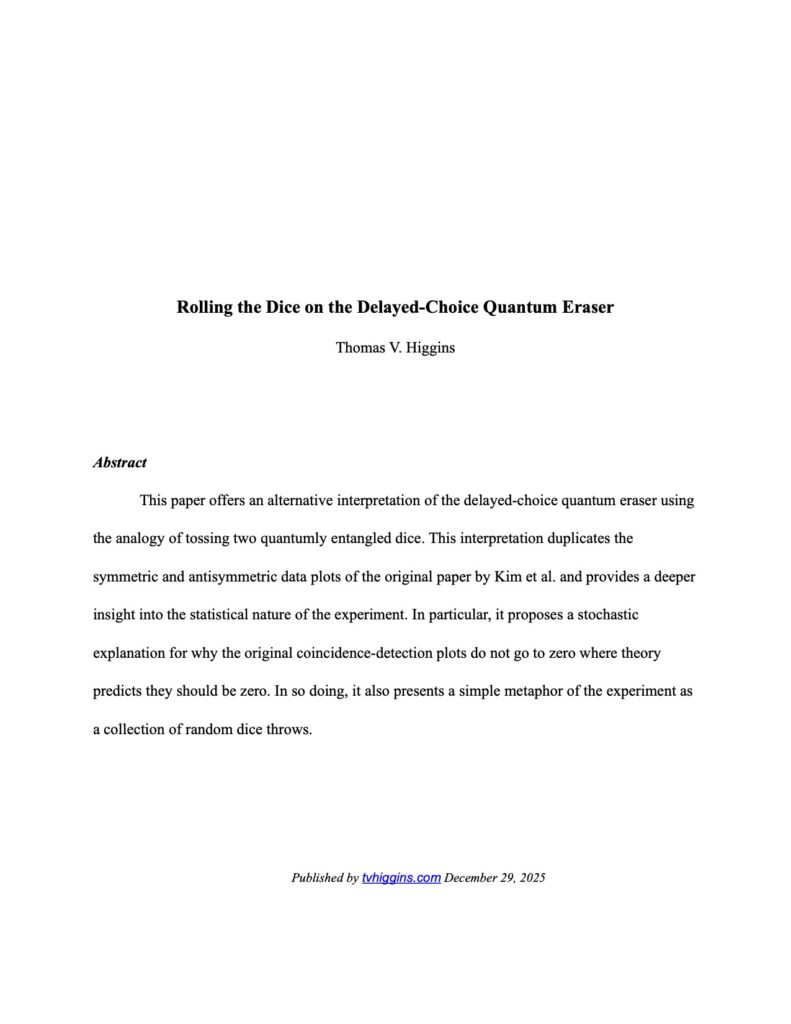
"Rolling the Dice on the Delayed-Choice Quantum Eraser": A new interpretation.
Download Paper

The delayed-choice quantum eraser has confounded many people for well over two decades, now. During that time, its peculiar results have spawned some pretty far-fetched interpretations, including the notion that the experiment demonstrates so-called “retrocausality,” in which effects precede causes. Not true. It turns out that it’s really a sorting machine, not a time machine.

Much of the challenge in comprehending this experiment stems from the scarcity of operational details given on it, starting with the original paper by Kim et al. Vital specifics are often ignored or taken for granted, leaving the uninitiated to fend for themselves.

Another obstacle for many is understanding the nature of the entanglement that exists between the photons bouncing around between detectors in the experiment, as well as the degree of coherence they exhibit during these interactions. Entanglement is the hardest aspect of the experiment for most to swallow—even Einstein called it “spooky action at a distance.”

Modern quantum theory offers some helpful mathematical guidance for dealing with entanglement. The following YouTube video gives an excellent quantum mechanical summary of the delayed-choice quantum eraser: https://www.youtube.com/watch?v=SCdbMhQ8Wrk.

Entanglement, according to QM, kills interference, which accounts for why we don’t see fringes at the scanning detector D0 in the experiment. Because of this effect, only a statistically mixed ensemble of the possible pure quantum states exists at the signal detector D0. To the eye (and to D0), this combination of mixed states looks like the clump pattern from the sum of two single-slit states. No interference fringes.

But coherence is not so much destroyed by entanglement as it is rendered inaccessible to direct local measurement. Consequently, to disentangle a pure state from the ensemble of mixed states at D0, you must combine each detection at D0 with its entangled twin’s detection at one of the other four detectors. It’s as if the pure state exists only “in spirit” at D0., and to interact with it you must enlist the help of a “medium” in the form of correlated twin detections. This is because the full wavefunction is actually shared by the entangled photon pair, so it takes a series of correlated detections to get the full story.

Nonetheless, despite the loss of local coherence caused by entanglement—and, indeed, because of it—the results of the delayed-choice quantum eraser can be accurately modeled using the metaphor of two quantumly entangled dice. In the paper presented above, I describe how such a model can reconstruct the symmetric and antisymmetric coincidence data of the original paper by Kim et al., thus providing a deeper insight into the stochastic nature of the experiment and contradicting those infamous “retrocausal” interpretations of it.

To download the PDF of this paper click here or on the abstract page imaged above.

To download the PDF of my backgrounder on this famous experiment, click “Disentangling the Delayed-Choice Quantum Eraser.

Disentangling the Delayed-Choice Quantum Eraser

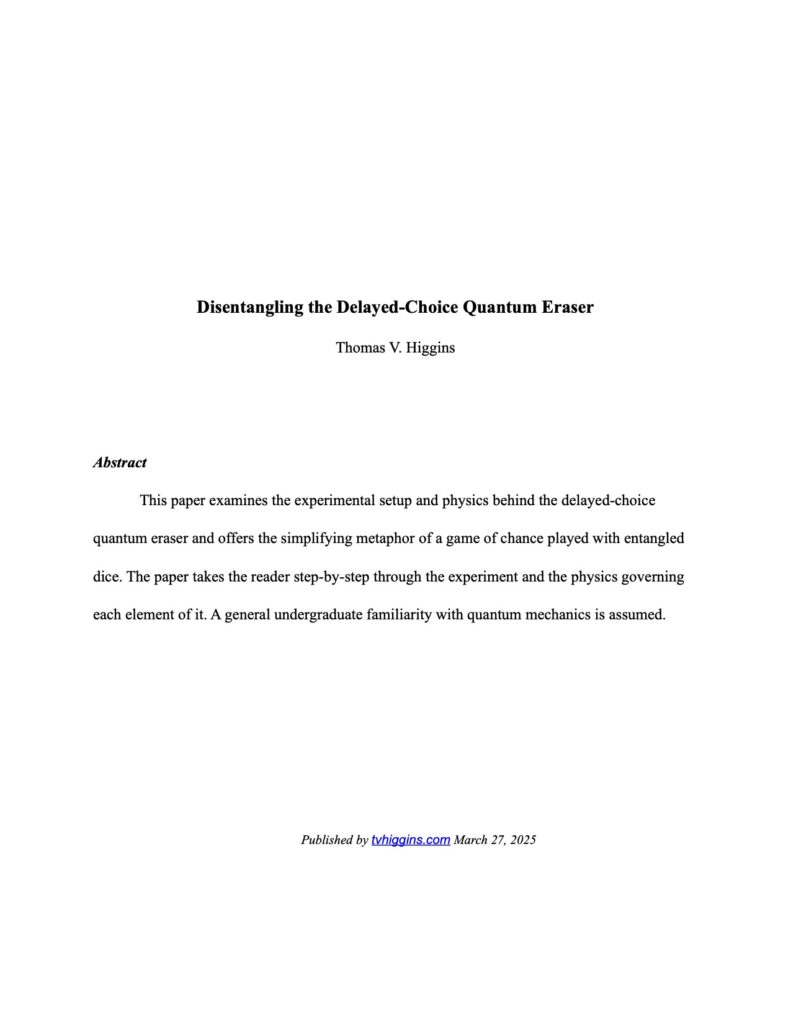
Image of abstract to the paper "Disentangling the Delayed Choice Quantum Eraser"

Download

Twenty-five years ago, Yoon-Ho Kim and others published a paper in Physical Review Letters entitled “A Delayed Choice Quantum Eraser,” which caused quite a stir in the popular science media. Before long, a collection of books and articles appeared making some pretty far-fetched claims about an experiment that turned the arrow of time on its head and challenged the normal sequence of events from past to present.

I first became aware of the experiment in 2005 after reading a review article by Y. Aharonov and M.S. Zubairy in the journal Science (Science 307, 875). The review article piqued my interest enough that I then read the original paper by Kim et al. It was scant on details, but this concluding statement caught my eye:

“The experimental results demonstrate the possibility of observing both particle-like and wave-like behavior of a light quantum via quantum mechanical entanglement. The which-path or both-path information of a quantum can be erased or marked by its entangled twin even after the registration of the quantum.”

The authors didn’t straight-up claim that they could reach out from the present and change the past, but the idea of “erasing” quantum information after-the-fact came pretty close. That’s when I called my friend E. Brian Treacy. After kicking it around for a while, we decided to write a different interpretation of the experiment and submit it to Physical Review Letters, which we did. They rejected it because we purposefully avoided invoking quantum entanglement in our interpretation, which in retrospect was a mistake on our part because entanglement does play an important role in the experiment.

One useful way to think of the delayed-choice quantum eraser experiment, and of entanglement in general, is to imagine a pair of identical twins. For example, if you happen to notice a physical trait on one twin that you hadn’t noticed before on the other twin, you’ve just made a “delayed” observation or “choice.” And because they are twins, you also know that the same traits of one will likely appear on the other, too.

The delayed choice part of the delayed-choice quantum eraser.

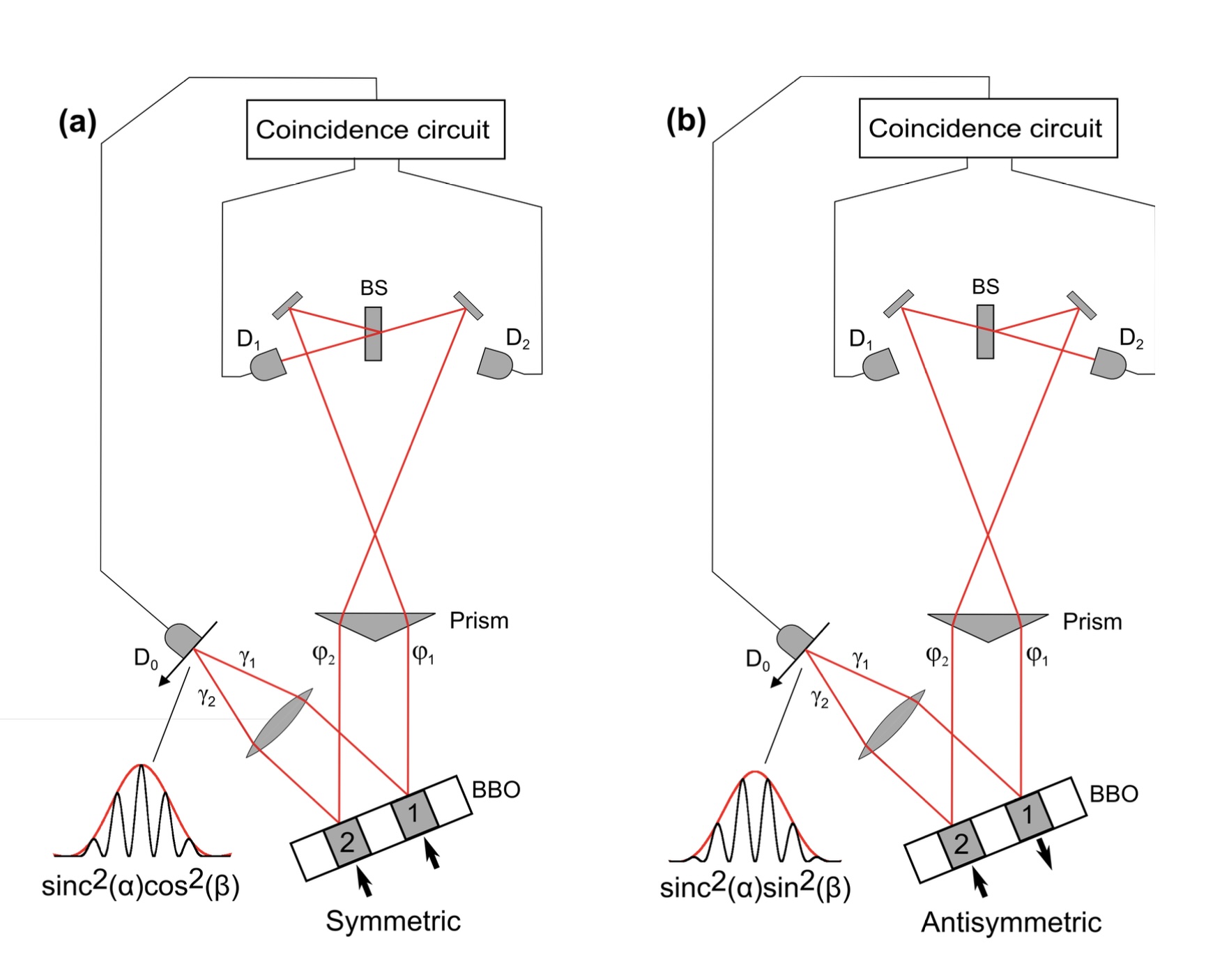
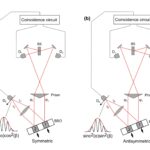
Figure 2 from our original 2005 paper depicts the “delayed-choice quantum eraser” used to sort the symmetric (a) and antisymmetric (b) states in the famous experiment by Kim et al.

The original experiment by Kim et al. demonstrated a similar effect (see figure above). By inducing interference among photons at one location and time, the experimenters demonstrated that their entangled photon twins, which had been detected earlier at another location, suddenly showed interference, too, even though they ordinarily displayed no such interference by themselves. In fact, the interference of a set of photons could be seen or “erased,” depending on how their entangled twins were detected at a later time. The present is not mysteriously affecting the past here, as some have proclaimed, it’s only revealing to you a common trait among twins that was shared all along but that you just didn’t (or couldn’t) see before.

Of course, the original experiment is more complicated than this, and there are other aspects to it, but it remains an elegant example of the spooky quantum property of entanglement in which the properties of multiple quanta can become correlated with one another and instantaneously act like a single quantum across space and time.

More recently, a number of publications (and even a couple of YouTube videos) have appeared debunking “retrocausal” interpretations of the delayed-choice quantum eraser. Most of these criticisms point out that the original experiment by Kim and others is really a kind of sorting machine, which is exactly the point that Brian and I tried to make back in 2005.

Brian is gone, now, so I’ve rewritten our original 2005 paper myself, but with entanglement included this time. This one’s for you, Brian.

Here’s a PDF of the revised paper:

The quantum eraser section of the delayed-choice quantum eraser

Delayed Choice Quantum Eraser

I also introduce a new interpretation of the delayed-choice quantum eraser in my paper “Rolling the Dice on the Delayed-Choice Quantum Eraser.” This interpretation explains the experiment by using the stochastic metaphor of tossing two quantumly entangled dice. (An overview of this interpretation can be found in my posting “Rolling the Dice on the Delayed-Choice Quantum Eraser.”)
See also my followup paper “Quantum Dice and the Delayed-Choice Quantum Eraser,” which applies the quantum-dice interpretation more fully to reproduce the entire data set of the experiment.